27/10/2026
There you are, in the kitchen, ready for a slice of toast and a decent brew. You reach into the cupboard for the honey, twist the lid off and find that what was once golden and runny has turned thick, grainy and almost solid.
Has it gone off? Has it been stored incorrectly? Or have you bought a jar that's somehow past its best?
Don't worry. Before you chuck it out or push it to the back of the cupboard, there's something worth knowing.
Honey going hard is usually a perfectly natural process, and in most cases, there's absolutely nothing wrong with it.
In fact, that jar of crystallised honey is a lovely little reminder that honey is a natural product, and nature doesn't always do things the way we'd expect.
So, let's get to the bottom of it.
Why does honey crystallise?
Honey is made up mainly of two natural sugars: glucose and fructose, alongside water and small amounts of other substances.
Glucose doesn't stay dissolved in honey as easily as fructose does. Over time, the glucose can separate from the water and form tiny crystals. As more crystals develop, the honey becomes thicker, grainier and eventually firm.
This process is called crystallisation, although you might also hear people call it granulation or setting.
And here's the interesting bit: different honeys crystallise at different speeds.
Honey with a higher proportion of glucose tends to crystallise more quickly, whilst honey with more fructose generally stays runny for longer.
The flowers the bees have visited influence this balance, which is one reason different varieties of honey behave so differently.
Temperature, storage conditions and tiny particles naturally present in honey can also affect how quickly crystallisation begins.
So, if one jar in your cupboard is still beautifully runny whilst another has turned solid, it doesn't automatically mean one is better than the other. They're simply behaving differently.
Is crystallised honey still safe to eat?
In most cases, yes.
Natural crystallisation doesn't mean honey has spoiled. Properly stored honey has a very long shelf life because its low water content and natural acidity make it an unfavourable environment for most microorganisms.
Crystallisation is a change in texture, not a sign that the honey has gone bad.
You might find that set honey tastes a little different because its texture changes how the sweetness and flavours come through, but it can still be enjoyed just as you would when it was runny.
There are, however, a couple of things to watch for. If your honey smells fermented, develops an unusual froth or appears to have become contaminated with water or other substances, don't assume crystallisation is the explanation. Honey that has been diluted or contaminated can spoil.
For an ordinary jar that's simply turned thick and grainy, though, there's generally no need to worry.
How to turn crystallised honey back to runny
If you prefer your honey runny, the good news is that you can usually bring it back without much fuss.
You don't need any special equipment, and you certainly don't need to waste a perfectly good jar.
Here's how to do it.
The warm-water method
1. Find a suitable bowl
Choose a bowl large enough to hold your honey jar. If the honey is in a plastic container, check that it's suitable for warming and follow the manufacturer's instructions.
2. Add warm water
Fill the bowl with warm water, not boiling water, and stand the securely closed jar in it. Keep the water below the lid so it doesn't seep inside.
3. Give it time
Let the warmth gradually soften the crystals. Gently swirl the jar occasionally and replace the water when it cools. Larger or more firmly set jars will take longer.
The key is patience. Gentle warmth will gradually dissolve the crystals, whereas excessive heat can damage some of honey's delicate flavour compounds and natural enzymes.
You don't need to get the honey piping hot. Take your time, and stop once it's reached the consistency you want.
One thing to remember: honey can crystallise again as it cools. That's perfectly normal, so don't be surprised if you need to repeat the process in the future.
Can you stop honey from crystallising?
Not entirely. Some honey crystallises quickly, and some stays runny for a long time. You can't completely prevent a natural process without altering the honey.
But you can influence how quickly it happens.
Keep the lid tightly closed. Honey can absorb moisture from the air, so a properly sealed jar helps protect its quality.
Store it somewhere cool and dry. A cupboard away from direct sunlight and heat is ideal.
Avoid extreme temperature changes. Crystallisation is influenced by temperature, and cool conditions can encourage it. A stable cupboard temperature is a good everyday choice.
Use a clean, dry spoon. Introducing water or food particles into the jar can affect its quality and storage life.
You don't generally need to refrigerate honey. In fact, colder conditions can encourage some varieties to crystallise more quickly.
And don't worry if you've done everything right and your honey still sets. That's simply part of the nature of honey.
Why does some honey set faster than others?
This is where things get particularly interesting for anyone who enjoys trying different honeys.
The variety makes a difference, and the contrast between jars can be quite remarkable.
Blossom honey can vary considerably because it's made from nectar collected from different flowers. Depending on its natural sugar balance, it may remain runny for some time or begin crystallising relatively quickly.
Oilseed r**e honey, often associated with spring blossom in the UK, is particularly well known for crystallising quickly. It can set into a pale, fine-grained honey, which is why it's commonly used to make soft set honey.
Heather honey is a little different again. Ling heather honey is naturally thixotropic, meaning it can form a gel-like structure that becomes more fluid when stirred or agitated. It can also have a distinctive texture, quite unlike an ordinary runny blossom honey.
These differences are part of what makes exploring honey so interesting. The colour, flavour and texture all tell you something about the flowers and the natural composition of what's in the jar.
Crystallisation alone, however, isn't a reliable way to identify the flowers or prove where a honey came from.
Should you buy runny honey or set honey?
Honestly, neither is automatically better. It comes down to what you like and how you plan to use it.
If you're a fan of a drizzle over porridge, yoghurt or warm pancakes, runny honey might be your first choice.
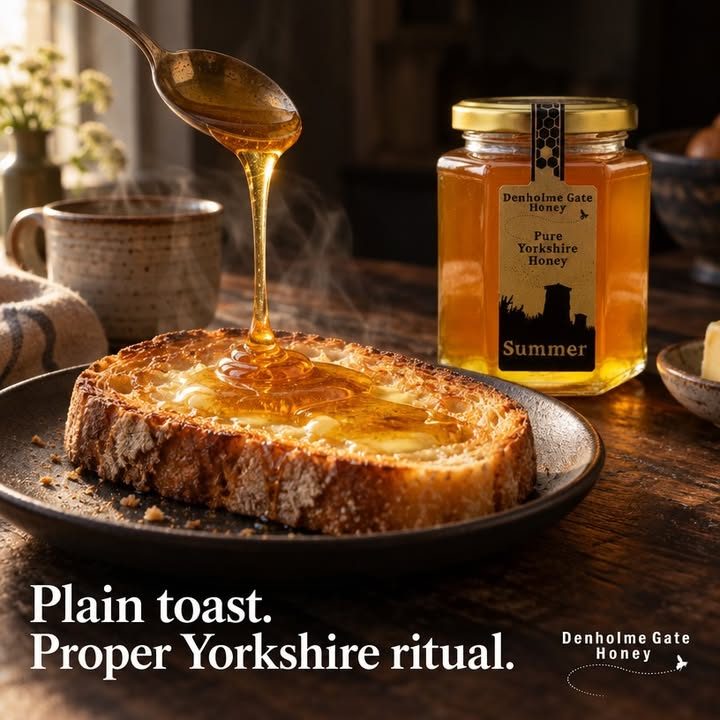
If you prefer spreading honey thickly onto hot toast without it running off the edges, set honey could be just the thing.
And if you're baking, cooking or making a salad dressing, either can work. If your recipe needs honey to pour easily, gently warm a set variety first.
There's no need to treat crystallisation as a fault or assume that runny honey is fresher. Both textures can be perfectly natural, and both have their place in the kitchen.
A final word from the kitchen
There's something reassuring about knowing that a jar of honey doesn't have to stay exactly the same from the day you open it.
It might be golden and fluid when you first bring it home, then gradually turn creamy, grainy or firm as the weeks pass. That's not necessarily a problem to solve. It's simply one of the ways natural honey behaves.
So next time you find a solid jar at the back of the cupboard, don't write it off.
Put the kettle on, warm the jar gently in a bowl of water if you'd prefer it runny, and get the toast on.
And if you like it just as it is, spread it thickly and enjoy it.
After all, a good jar of honey deserves better than being forgotten at the back of the cupboard.
Denholme Gate Honey - made for Yorkshire mornings.