11/03/2026
YOUR DOG’S TRAINING DOESN’T END WHEN CLASS IS OVER!
One of the biggest challenges I see as a professional dog trainer isn’t necessarily the dog. It’s the lack of consistency and follow-through from the person on the other end of the leash.
Let’s talk about something incredibly important.
If the ONLY time you work with your dog is when you show up to training class once a week, you are missing the entire point of training.
Training class is where you learn. It’s where we introduce skills, address problems, work through challenges, and teach YOU how to communicate effectively with your dog.
But the real training? That happens at HOME and in your everyday life.
Your trainer cannot do the learning for you.
I can demonstrate techniques, explain canine behavior, show you how to communicate, help you understand why your dog responds the way it does, and guide you through correcting problems.
But I cannot go home with you and reinforce those lessons every single day.
And here’s something I tell people frequently:
I am not just training your dog. I am teaching YOU how to train your dog.
Your dog needs to understand and respond to YOU, not just the trainer standing beside you.
Dogs don’t automatically generalize what they learn.
Just because your dog performs a beautiful recall, sit, stay, or loose-leash walk during class doesn’t mean that skill will automatically transfer to your living room, backyard, a busy sidewalk, or a trail full of distractions.
Those skills need to be practiced in different environments, under different circumstances, and with increasing distractions.
That’s how you develop reliability.
Consistency matters more than occasional marathon training sessions.
You don’t need to spend an hour every day drilling obedience.
Five to ten minutes here and there, incorporated into everyday activities, can make a tremendous difference.
Practice recalls while doing chores. Work on leash manners during walks. Reinforce impulse control around doors, visitors, and feeding time. Teach your dog to pay attention to you even when something exciting is happening.
Training should become part of how you LIVE with your dog, not something you only do on Sundays.
Behavior problems don’t magically disappear because you attend classes.
Reactivity, jumping, pulling, excessive barking, poor recall, and other unwanted behaviors require consistency outside the training environment.
If you spend an hour learning how to address a behavior in class but allow that same behavior to be practiced and reinforced the other six days of the week, you’re working against your own progress.
And sometimes, without realizing it, owners are the very ones reinforcing the behaviors they’re trying to eliminate.
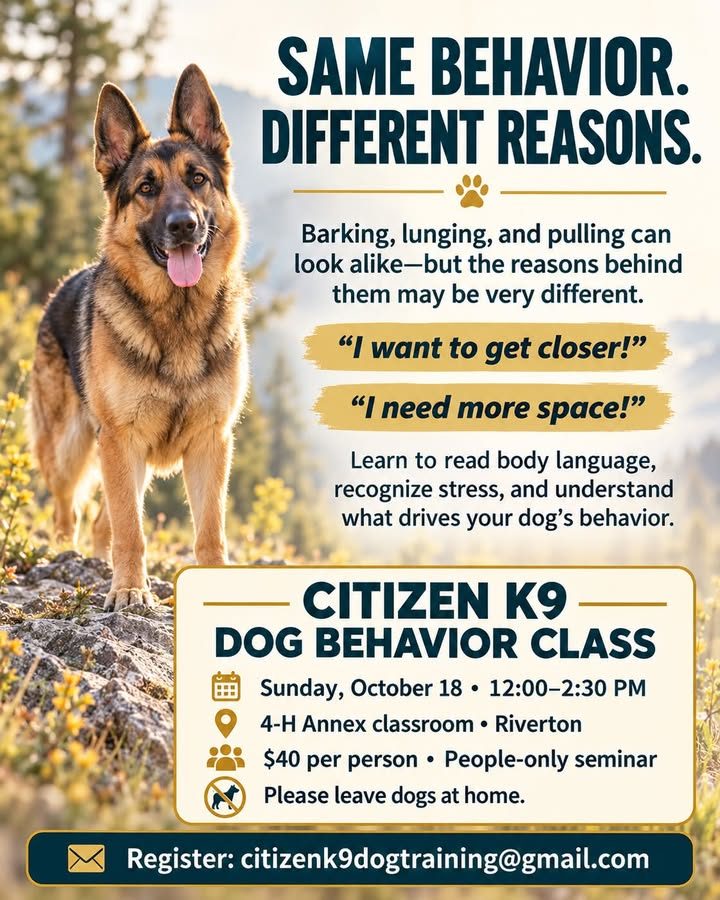
The most important thing you will learn is how to understand your dog.
Learn to read body language. Understand motivation, stress, excitement, frustration, and how your own timing and responses influence behavior.
Learn WHEN to reward, WHEN to redirect, and WHY your dog is doing what it’s doing.
A dog that only listens when a trainer is present, when a treat is visible, or when a particular piece of equipment is attached isn’t the ultimate goal.
The goal is a dog that understands you, trusts you, and can work WITH you in everyday situations.
And that takes a relationship built through communication, consistency, and practice.
THE BOTTOM LINE:
You can attend every class available, hire the most experienced trainer, and spend thousands of dollars on training.
But if you aren’t willing to learn, practice, and consistently work with your dog, you’re unlikely to achieve the results you’re looking for.
Your trainer is your teacher and your guide. YOU are your dog’s everyday trainer.
At Citizen K9, I don’t expect perfection. I don’t expect you to have everything figured out after one class. That’s why we’re here!
What I do expect is a willingness to learn, to practice, to ask questions, and to put in the effort.
Because ultimately, the success of your dog’s training depends far more on what happens between classes than what happens during them.
Train the dog in front of you. Learn to communicate. Be consistent. And remember, training is a lifelong process, not a one-hour appointment.
Citizen K9 Dog Training & Agility
Teaching people to understand their dogs, not just teaching dogs to obey.