11/10/2026
!!!HOT TOPIC TUESDAY!!! (Part 1 of 3)
The information I will cover for you over the next three hot topic Tuesdays are not only a fundamental to the way I look at every single horse every.single.day, it is also an important conversation you need to hear, and information you need to be thoughtful about when you handle any horse (or even purchase one).
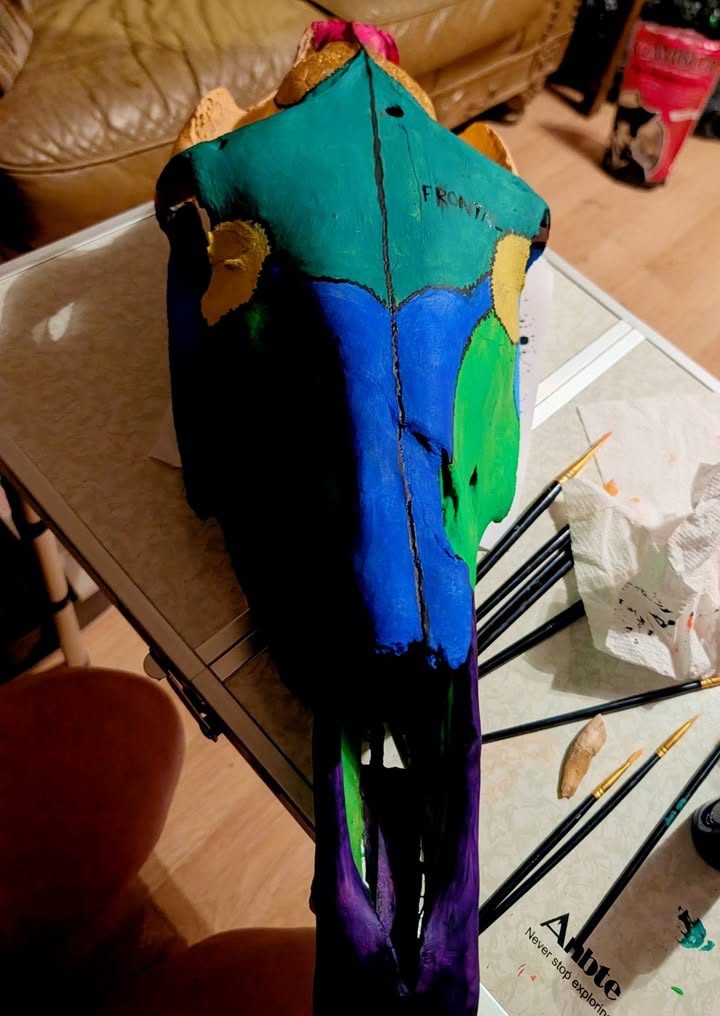
I just don't think we talk about the skull, the mouth, and the nervous system: their connections in health and dysfunction, and the neurological relationships involved in all of those components.
Think about it: there is a neurological relationship between the skull, the teeth, the jaw, the poll, and the rest of the body.
Let's dissect this:
*the teeth are suspended in their sockets by periodontal ligaments
*the brain is cushioned by cerebrospinal fluid
*the skull contains a very complex network of nerves, muscles, fascia, and blood vessels
What happens when we have dental occlusions or other imbalances, TMJ dysfunction, chronic muscular tension, or discomfort in the poll?
In my opinion, we are no longer dealing with a mechanical problem. Again, I am no vet and cannot make any diagnosis; however, I can tell you what I'm feeling, where and what I know to be true about their bodies.
The trigeminal nerve alone is responsible for a majority of facial sensation; the face and mouth, but it also plays an important role in chewing. When there is altered sensation in these structures, you will no doubt see changes in chewing, facial sensitivity, muscle guarding, and head/neck position.
Knowing all of that, those of you that have worked with me in any capacity also know that my brain will take it further than that.
What of the craniosacral relationships? fascial connections? neurological responses that are contributing to dysfunction?
THere is a direct relationship between pain, sensory input, and muscular responses and craniosacral mechanics as well as their neurological effects.
When I'm evaluating a horse, and asking a gazillion questions, I'm thinking about all of these systems and how they are interacting. I'm asking about the last time their teeth were floated or if the poll has been addressed so that I can be more thoughtful about their nervous system and what modality would be most beneficial.
Why? Because the nervous system is involved in almost everything that horse does. Looking at a single component, in my opinion and experience, will never solve the issue at hand.
we need to look at the whole horse, and I need the input from you and from your horse to get that. This is part of the reason the first session with me takes so long. It takes a lot of pictures (and a lot of phone memory!!), some videos, a lot of conversation, and a lot of physical/mental work to understand the global picture.
This video of Cash from 2022 is the perfect example of facial indications and a combination of trauma and compensation, plus the unravelling of all of the dysfunction in the skull during the healing process. It's still one of my all time favorite cases. I remember just telling Cyra I can't promise anything but I can certainly try by dang-est. I'm super proud of the outcome; It's one I couldn't get if I didn't keep my investigative hat on for sure.
Are you looking at the whole picture of your horse? or just a single component? The more you know, the easier it is to see the entire horse, all of the overlaying components, and the systems in place that balance their entire body. If you're having trouble or feel stuck, I'm here to help you! You don't have to be local to me. You don't even have to be a client. let's talk. You never know what a different perspective will offer you.
Next hot topic Tuesday? part two in this series: what happens when the nervous system starts changing the way a horse moves...
Stay tuned, it'll be a good one.